wp-web2Blending Web 2.0 Technologies with Traditional Formal Learning
A Guide for CLOs and Training Managers

rapid_intake_scaling_elearning_developmentHow to Scale Your Training Organization to Meet Growing Demand for eLearning
Growing demands for eLearning require a combination of methodologies, tools, and technologies to effectively scale by e-learning development throughout the organization.

wp-leadership-paperSkillsoft White Paper
Extending Reach and Ensuring Effectiveness of Leadership Development: The Role of Technology-Based Learning

Upcoming eLearning Events


107 Articles match "2002","Informal"

The Latest from the eLearning Learning Community

Tuesday, August 31, 2010
information as cited by Lawanto, 2010) It has also been defined as a process by which the brain organizes and monitors cognitive resources. 2002) Aplying cognitive strategies to instructional design. 2002, December). The short definition of Metacognition is "Thinking about Thinking." Cuasay, 1992). References: Bourne,L. In R.S.
 
Sunday, August 1, 2010
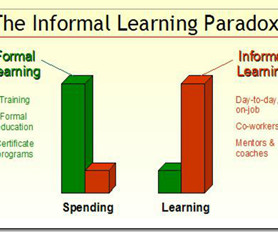
Learning Gets Social by Tony Bingham: Karie Willyerd, vice president and chief learning officer for Sun Microsystems explains the huge opportunity the profession has in informal learning: “One of the things that has happened is that we have focused so much on the 10 percent [formal learning] that we abdicated the 70 percent [informal learning].
 
Wednesday, July 7, 2010
Here are eight myths that you often hear, and some expert information to the contrary. Brain Rules & learning - Informal Learning , June 13, 2010 Neuroscientists have figured out a lot about how the brain works in the time since the fMRI was invented 18 years ago. Best of eLearning Learning. June 2010. like Kate a lot. Seriously.
 

The Best from the eLearning Learning Community

converting information into effective strategy) and everyone else (i.e. the knowledge management specialists) seems to be focused on structuring the information. (originally posted by Peter Isackson) Curiously, Clark and I don't seem to know for certain whether we "furiously" agree or not. tend to agree with Clark that we do agree!
The *only* reason I can see to do this is if you use that information to drop out any content that the learner already knows. (originally posted by Clark Quinn) Well, I really want to reply to Peter, but right now I've got a bee up my bonnet, and I want to vent (how's that for mixing my metaphors?). I'll get to Peter's comments in a moment.
Harm told me about his team’s experience with informal learning in an engagement with Sara Lee. Having a closer look, I concluded that the list of activities could be divided into more formal and more informal learning activities. Informal: - Experiences on the job. The research was conducted in 2002. Networking.
Microlearning – the learning that results from “micro” content published in short form and limited by the software and devices used to view it – offers alternatives to traditional development methods for workers who deal with web-based information as part of their job. Current context since 2002. My side comments are in italics.
Wednesday, May 31, 2006 e-Learning Success in Manufacturing This article is kind of old (from 2002), but provides insight into the successes achieved by one manufacturing organization. Cammy Beans Learning Visions Musings on eLearning, instructional design and other training stuff. Take the Survey! The eLearning Salary Gender Gap Phew!
I’ve posted an overview of the course (as well as an earlier rudimentary attempt from 2002) on my connectivism blog: Socialization as information objects. I finally got around to capturing a few thoughts on CCK08. Now, to get ready for CCK09…
News & Information. Stuffed with information. Goldmines of information. Information Technology Association of America. -- 900,000 jobs to fill! TechLearn 2002. Training 2002 February 18 - 20, 2002 Atlanta, GA. Online Learning 2002. Online Learning 2002 Europe March 5 - 6, 2002 London.
How does Twitter as an informal learning tool apply to people in organizations? In turn, their access to information and knowledge is only as good as their sources, generally only within their organization. Informal learning is the unofficial, unscheduled, impromptu way people learn to do their jobs.” 2002). 2000). 2007).
Learning relies both on granting the individual an active voice and creating an environment for collective listening and mutual support (UNESCO, 2002).” had intended to highlight how important the personal and collaborative elements are to my ‘informal’ learning in the blogosphere. Social Networking Informal Learning Web 2.0