421 Articles match "Performance Support"

The Latest from the eLearning Learning Community

Friday, July 3, 2009
This article originally appeared in Training Journal in June 2009 (PDF). In it I coin the term Ubiquitous Performance Support (UPS) as a better description of how workplace place learning will develop in the future. Comments welcome. ---------------------------------------------- Lars Hyland investigates how Continuous Professional Development is being transformed by digital connectivity and ...Tags: social networking e-learning blended learning work place performance UPS performance support elearning CPD.
 
Thursday, July 2, 2009
Rather, we recommend redeploying them in new capacities, serving as connectors, wiki gardeners, internal publicists, news anchors, and performance consultants." Then, after describing some of the tasks and skills that will be increasingly needed in organizations, he concludes with: "These tasks won’t happen by themselves.... We’re all in this together. Some instructors will continue to instruct, but they will increasingly do so with network support and in smaller bursts. It’s a better use of their time.
 
Wednesday, July 1, 2009
This month’s big question asks, “In a Learning 2.0 world, where learning and performance solutions take on a wider variety of forms and where churn happens at a much more rapid pace, what new skills and knowledge are required for learning professionals.... Here are some of the core capabilities identified: 1.
 

The Best from the eLearning Learning Community

Informal Learning Blog ← Enterprise learning Join our dialog about the Un-book → Whatever Happened to Performance Support? August 24th, 2008 | general Where did the dinosaurs go.... One group of dinosaurs did survive the asteroid crash: today we call them birds. And what happened to performance support? In the 1990s, many people expected performance, to shove technical training into the shadows.
Great post by Jay Cross that uses the history of performance support to set up the need for what Jay calls Learnscapes. I've been a long-time believer in EPSS and ePerformance . Jay tells us: Performance support is blossoming in organizations today under the label of Web 2.0. Remember the original premise of PS, making information available to workers instead of forcing them to memorize it?
I’d love to hear some of your suggestions and experiences. 1. Understand the job 2. Link Learning to business process 3. Build a performance support system 4. Build a community of practice 5. Use social media to facilitate informal learning 6.... Build a Performance Support System A Performance Support System is a concept more that a specific solution.
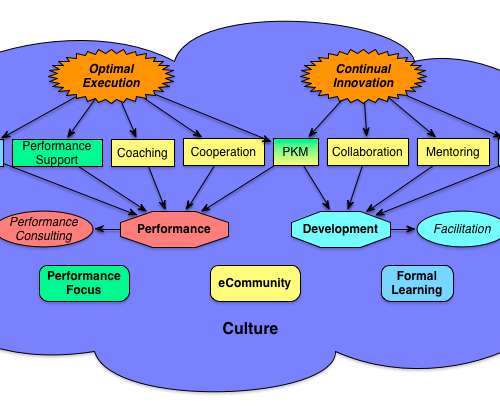
For almost a decade I've been building a model of how learning works to prompt performance. Each iteration gets better (in my unbiased opinion). Here's the latest one--this one has the advantage of pointing out the responsibilities learning professionals have AND the responsibilities that learners' managers and the workplace have in creating on-the-job results. You can use this model for two purposes: As a visual metaphor for how learning works to drive on-the-job performance and results. As a job aid to assign responsibilities and tasks.
For example, an article ( Redesigning the HR organization ) by organizational design specialist Amy Kates describes a matrix organization structure that could support the complexity of a merged performance improvement unit.   Her award winning model targets HR but I see many useful features for supporting an even broader organization....
Tags: Learning Design e learning performance consulting performance support ADDIE authentic learning tasks Instructional design.....
You can see evidence of the struggle in this definition of informal learning provided in the ASTD report: “After careful deliberation, the researchers arrived at the following definition: “a learning activity that is not easily recognizable as formal training and performance support... informal learning performance consulting performance support collaborative learning social learning.
I don’t usually get information about training and performance improvement in the Wall Street Journal but this article clearly spells out the benefits of linking training directly to the workplace....
Understand the job 2. Link Learning to business process 3. Build a performance support system Of Tom’s 10 suggestions, not one is related to creating a course. That shows how relevant training is to the integration of working & learning and something to consider at the dawn of the learning age....
Think of your course content like a supermarket. The shelves are filled with all sorts of items. Give the learners a shopping list (performance expectations) and let them do the shopping.