434 Articles match "PowerPoint"

The Latest from the eLearning Learning Community

Monday, June 29, 2009
A couple really stood out. Sarah Williams (of inContact) presented a session entitled The Missing Link: Rehumanizing eLearning . Sharp, engaging, with a razor wit and a beautiful PowerPoint presentation - Sarah demonstrated exactly what a workshop should be.
 
Monday, June 29, 2009
For the last week I have been in storyboard mode for a large course I am creating. Since grad school I have been using the same format for storyboards, when I do use them. Some projects benefit from use of storyboards, some do not, but that is another post . The storyboard I use is a very simple, but flexible format that we used in my school’s ISD program. I have made a few small changes to it.
 
Saturday, June 27, 2009
The organization then faces the challenge of working through complex issues in a manner that reflects organizational and external contexts. If it were simple, we could just write a blog post about it or deliver a one-slide powerpoint presentation. Corporate learners aren’t dumb. We don’t need to reduce significant training to pablum-like consistency.
 

The Best from the eLearning Learning Community

One of my clients is considering using PowerPoint as a development tool. Although they will probably convert the PowerPoint to Flash and distribute in this way, they also want to make the PowerPoint files available for users who wish to make modifications to the materials.
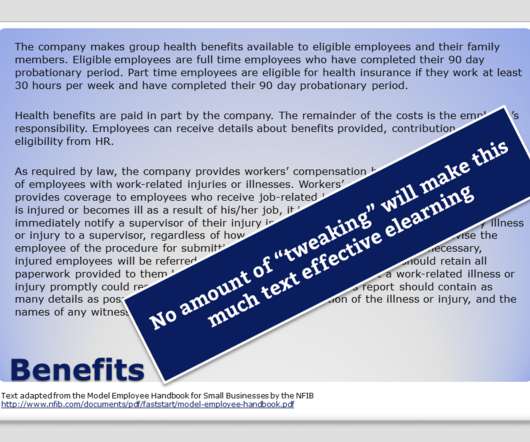
I was interested in Cammy Bean's News Flash:PowerPoint bad for learning . She cites research by the University of New South Wales which concludes that "it is more difficult to process information if it is coming at you in the written and spoken form at the same time.
I was interested to read in Donald Clark's review of Learning 2005 that Elliott had decreed that there should be no PowerPoint at the show. I can certainly sympathise with Elliott's intentions here - after all, we have all had to sit through far too many mind-numbing slides full of endless bullet points. However, I wonder whether PowerPoint is really the guilty party here.
With the debate about the vices and virtues of PowerPoint continuing to rage without any sign of a conclusion, I was pleased to be alerted to a new book by Stephen Kosslyn, Chair of the Department of Psychology at Harvard University. The promise of Clear and to the point (Oxford Univeristy Press, 2007) is in its claim to '8 psychological principles for compelling PowerPoint presentations.
Due to some new research , the appropriate use of PowerPoint is again a topic of discussion. I went back to look at different opinions expressed in the past, and I'm not sure that there's much consensus on whether we should use PowerPoint, how to use it appropriately, when it makes sense or when it doesn't and why. So, this month, The Big Question is... PowerPoint - What is Appropriate, When and Why? Please answer this question by posting to your own blog or commenting on this post. (For further help in how to participate via blog posts, see the side bar.
May's Big Question in the Learning Curcuits Blog is PowerPoint: what is appropriate, when and why? Now I have just finished a three part posting on the subject of visualisation, so the body of my answer to this question can be found there: The power of pictures - part 1 The power of pictures - part 2 The power of pictures - part 3 But I can't resist trying to draw my thoughts on the subject together in some way so here goes.

How to Insert YouTube Videos in PowerPoint Presentations Before you embed YouTube videos in PowerPoint slides, always think of the medium(s) you’ll use to deliver that presentation. Tutorial: How to embed YouTube Videos in PowerPoint It’s not uncommon to see presenters in conferences struggling to get the video right thus breaking the entire rhythm of their presentation...)? The reason I asked this is because each situation requires a different approach.
In reading Garr Reynold's excellent Presentation Zen (more about that in a later post), I came across a great idea for conferences and meetings called Pecha-kucha. Apparently, Pecha-kucha (Japanese for chatter) was started in 2003 by Tokyo expatriate architects Mark Dytham and Astrid Klein as an alternative presentation format. Each speaker has 20 slides, each of which must be shown for 20 seconds, with which to tell their story or make their point. The slides advance automatically and so after 6 minutes and 40 seconds you're done.
This month's LCB Big Question is on the Use of PowerPoint . In scanning around a bit for resources on this topic, I've found a few good starting points. I have tagged these in del.icio.us using the tag: lcbPowerPoint. I will continue to do so and you can find a current list at: http://del.icio.us/tag/lcbpowerpoint Research points the finger at PowerPoint Reports of the "Death of PowerPoint" greatly exaggerated Creating Presentations That Don't Suck! Stop your presentation before it kills again! Is it finally time to ditch PowerPoint?
Powerpoint turns 20 according to the Wallstreet journal. (sorry no link) That got me thinking about Learning...doesn't everything :-) I posted some interesting data on The eLearning Guild's Research blog regarding Powerpoint and Synchronous Learning Systems: PPT is still the most frequently used feature and has the highest ease of use rating.